Our top picks at a glance
Best overall
Blackstone 36" Griddle with HoodSee itPrice tier 3 of 4:$500–$1,500Families and entertainers who cook breakfast, burgers and fajitas outdoors.Best for small spaces
Blackstone 22" Tabletop Griddle with HoodSee itPrice tier 2 of 4:$150–$500Small households, balconies and camping.Best premium feel
Weber Slate GriddleSee itPrice tier 3 of 4:$500–$1,500People who want a griddle that looks and feels premium and is easier to maintain.Best for flexibility
Camp Chef Flat Top GrillSee itPrice tier 3 of 4:$500–$1,500Cooks who want a griddle but also want grill marks sometimes.Best from a big brand
Traeger FlatrockSee itPrice tier 3 of 4:$500–$1,500Traeger owners who want the same brand experience on a griddle.
Few outdoor cooking tools have exploded in popularity like the flat-top griddle. They're simple, fast, and great for the meals families actually cook: smash burgers, breakfast, fajitas, fried rice, quesadillas and more. Here are the best ones, and how to pick the right size.
Quick picks
- Best overall: Blackstone 36" Griddle with Hood
- Small spaces and tailgating: Blackstone 22" Tabletop
- Easiest maintenance: Weber Slate
How we picked
We compared griddles on cooking area, heat control, build quality, rust resistance, accessories and support. We confirmed Blackstone's current line-up and sizes on its product pages; for other brands we describe the product line in general terms because model numbers change often. See our methodology.
Our top picks
Best overall
Blackstone 36" Griddle with Hood
The griddle that launched a thousand smash burgers.
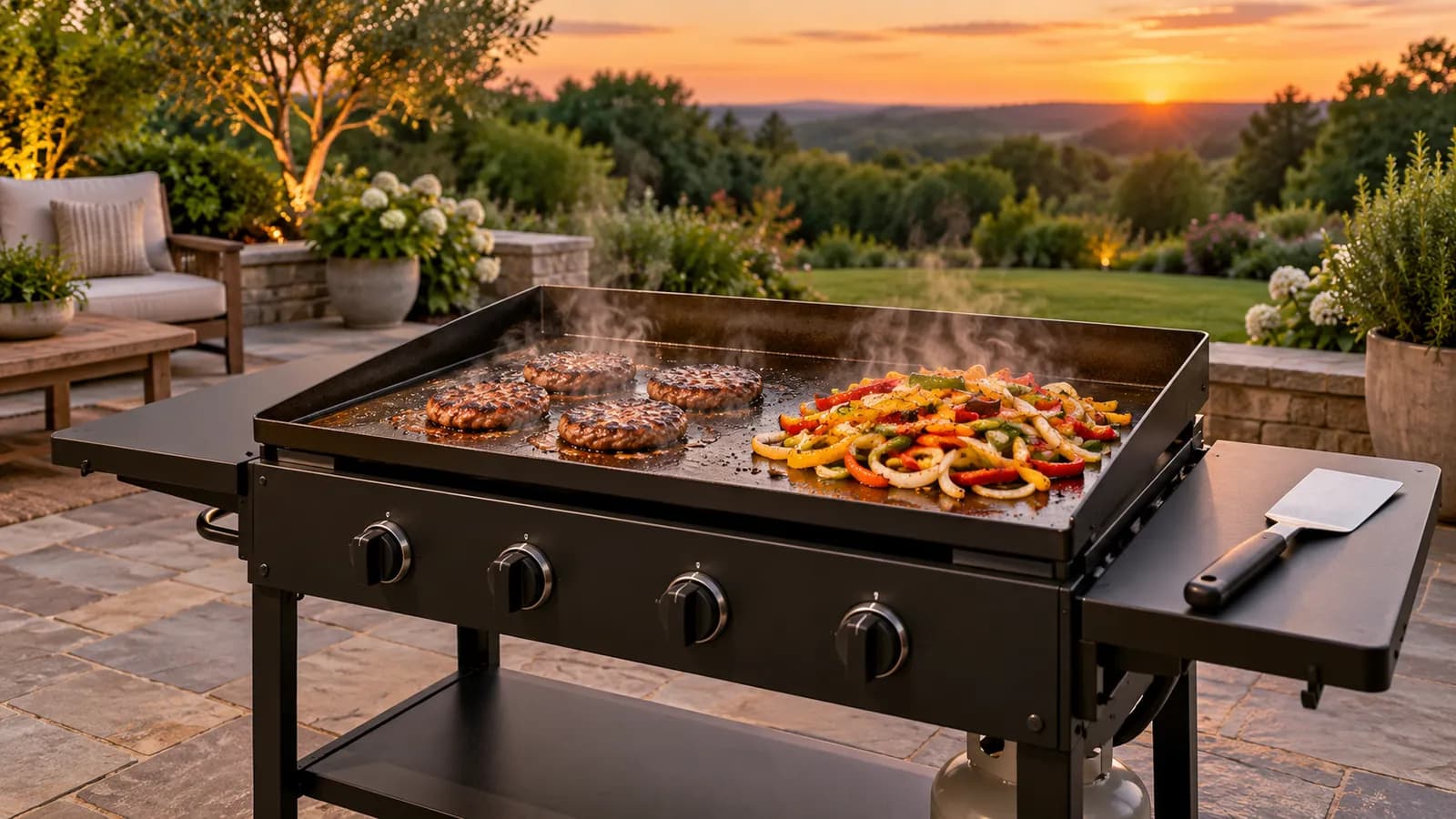
The 36-inch Blackstone with a hood is the griddle most people picture, and for good reason: lots of cooking space for breakfast or a crowd, a hood for melting cheese and steaming, and a huge community of recipes and accessories. Bare steel needs seasoning and care, and the footprint is large.
What we like
- Large cooking surface that handles breakfast for a crowd
- Hood lets you steam, melt cheese and keep food warm
- Huge community of recipes, accessories and replacement parts
Trade-offs
- Bare steel needs seasoning and regular care to prevent rust
- Takes up real patio space — and a propane tank
- Best for
- Families and entertainers who cook breakfast, burgers and fajitas outdoors.
- Skip it if
- You want grill marks or smoke flavor.
- Size: 36 in
- Fuel: Propane
Best for small spaces
Blackstone 22" Tabletop Griddle with Hood
The small-space griddle that's easy to tuck away.
A compact tabletop griddle with a hood that runs on propane cylinders. It's one of the cheapest ways to see whether you'll love griddle cooking, and it works on a balcony, a tailgate or a camping trip. The cooking area is limited when you're feeding more than three or four people.
What we like
- Compact enough for a balcony, tailgate or small patio
- Hood adds versatility, and propane canister fuel keeps it portable
- One of the lowest-cost ways to try griddle cooking
Trade-offs
- Limited cooking area when feeding more than 3–4 people
- Needs a table or stand
- Best for
- Small households, balconies and camping.
- Skip it if
- You regularly cook for 6+.
- Size: 22 in
- Fuel: Propane
Best premium feel
Weber Slate Griddle
A premium-feeling griddle with a rust-resistant surface.
Weber's griddle uses a rust-resistant cooking surface, so upkeep is easier than bare steel. You pay more than you would for a comparable Blackstone, and there are fewer accessories available.
What we like
- Rust-resistant cooking surface cuts down on upkeep compared with bare steel
- Weber build quality and a hinged, lid-friendly design
- Even heat across the surface
Trade-offs
- More expensive than Blackstone for similar cooking area
- Smaller accessory ecosystem
- Best for
- People who want a griddle that looks and feels premium and is easier to maintain.
- Skip it if
- You want the lowest-cost griddle or the biggest accessory ecosystem.
Best for flexibility
Camp Chef Flat Top Grill
A flat-top with a grill-box option for the best of both.
Camp Chef's Flat Top Grill is built around interchangeable cooking surfaces, so you can swap between griddle and grill grates. It's heavy-duty and well supported by accessories. Assembly takes patience.
What we like
- Interchangeable griddle and grill grates in many configurations
- Heavy-duty steel construction and a roomy cooking area
- Strong accessory support
Trade-offs
- Steel surface still needs seasoning and care
- Assembly takes patience
- Best for
- Cooks who want a griddle but also want grill marks sometimes.
- Skip it if
- You don't want to season and maintain a steel surface, or you dread a long assembly.
Best from a big brand
Traeger Flatrock
A griddle from the pellet-grill brand with a thoughtful design.
A griddle from the pellet-grill company, with multiple heat zones and a thoughtful grease-management system. It costs more than the best-known budget griddles; if you already like Traeger's service network, it's a natural add-on.
What we like
- Multiple heat zones help you cook different foods at once
- Quality build and a grease-management system that reduces mess
- Backed by a large retail and service network
Trade-offs
- Pricier than the best-known budget griddles
- Steel surfaces still require seasoning
- Best for
- Traeger owners who want the same brand experience on a griddle.
- Skip it if
- You're not already a Traeger fan and want the lowest-cost griddle.
What to know before buying
Size and burners
Griddles are sold by width: 17", 22", 28" and 36" are the common sizes. More burners mean more heat zones — you can sear in one area and keep food warm in another. Think about how many people you cook for and how much patio space you have (and where the propane tank will go).
Steel vs. rust-resistant surfaces
Traditional cold-rolled steel develops a nonstick "seasoning" with use but needs oiling and covering to avoid rust. Some premium models use surfaces that resist rust better, at a higher price.
Hoods and lids
A hood lets you melt cheese, steam vegetables and keep food warm, and it protects the surface when it's not in use. If you'll cook burgers, it's worth having.
Grease management
A good rear or side grease channel and a catch cup make cleanup much easier. Cheaper models can leak grease.
Accessories
Spatulas, scrapers, squeeze bottles, basting domes and cleaning stones make griddle cooking easier. Buy the tools first; add fancy accessories later.
Griddle or grill?
If you mostly want grill marks and smoke flavor, a griddle isn't a substitute. See our best gas grills, pellet grills and kamado and charcoal grills.
Frequently asked questions
Is a griddle better than a grill?
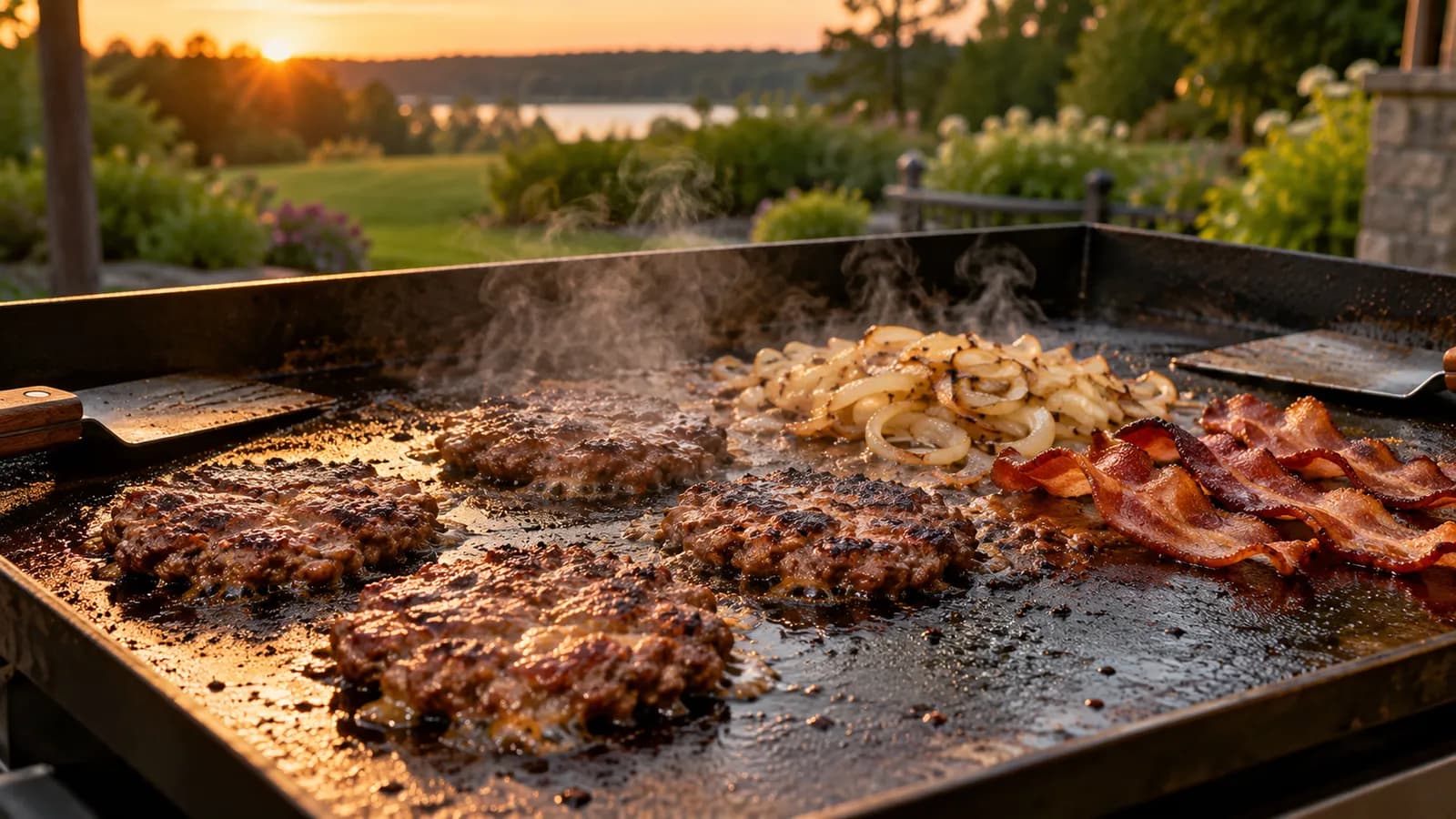
They do different jobs. A griddle is better for breakfast, smash burgers, stir-fry, fajitas and anything small or sticky. A grill is better for grill marks, smoke flavor and thick steaks.
How do I season a griddle?
Clean it, heat it until it smokes lightly, and wipe on a very thin coat of high-smoke-point oil (flaxseed, canola or a purpose-made seasoning). Repeat several times until the surface turns dark and glossy. Re-oil after each cook.
Do griddles rust?
Bare steel can rust if left wet or uncovered. Keep it oiled, use a cover or hood, and don't leave it out in the rain. Some surfaces, like Weber's, are designed to resist rust better.
What size griddle should I get?
A 22-inch griddle suits two to four people or tight spaces. A 28-inch is a flexible middle ground. A 36-inch handles breakfast for a crowd and is the best choice for families who entertain.
Alex Mercer brings 15 years of experience and a practical editorial approach to Backyard Review. Alex compares published product information, installation needs and ownership costs, highlighting trade-offs and distinguishing research from documented hands-on experience.