Our top picks at a glance
Best overall
Lay-Z-Spa AirJet seriesCheck pricePrice tier 2 of 4:$150–$500Anyone testing the hot-tub life before committing to an acrylic spa.Best step-up with real jets
Lay-Z-Spa HydroJet Pro seriesCheck pricePrice tier 3 of 4:$500–$1,500Buyers who want jets and better winter performance without going acrylic.Best for cooler weather
MSpa inflatable hot tubsCheck pricePrice tier 3 of 4:$500–$1,500Buyers who want a better inflatable without spending acrylic-tub money.Best widely available option
Coleman SaluSpaCheck pricePrice tier 2 of 4:$150–$500Casual use in mild climates.Best budget
Intex PureSpa PlusCheck pricePrice tier 2 of 4:$150–$500Price-sensitive buyers for summer use.
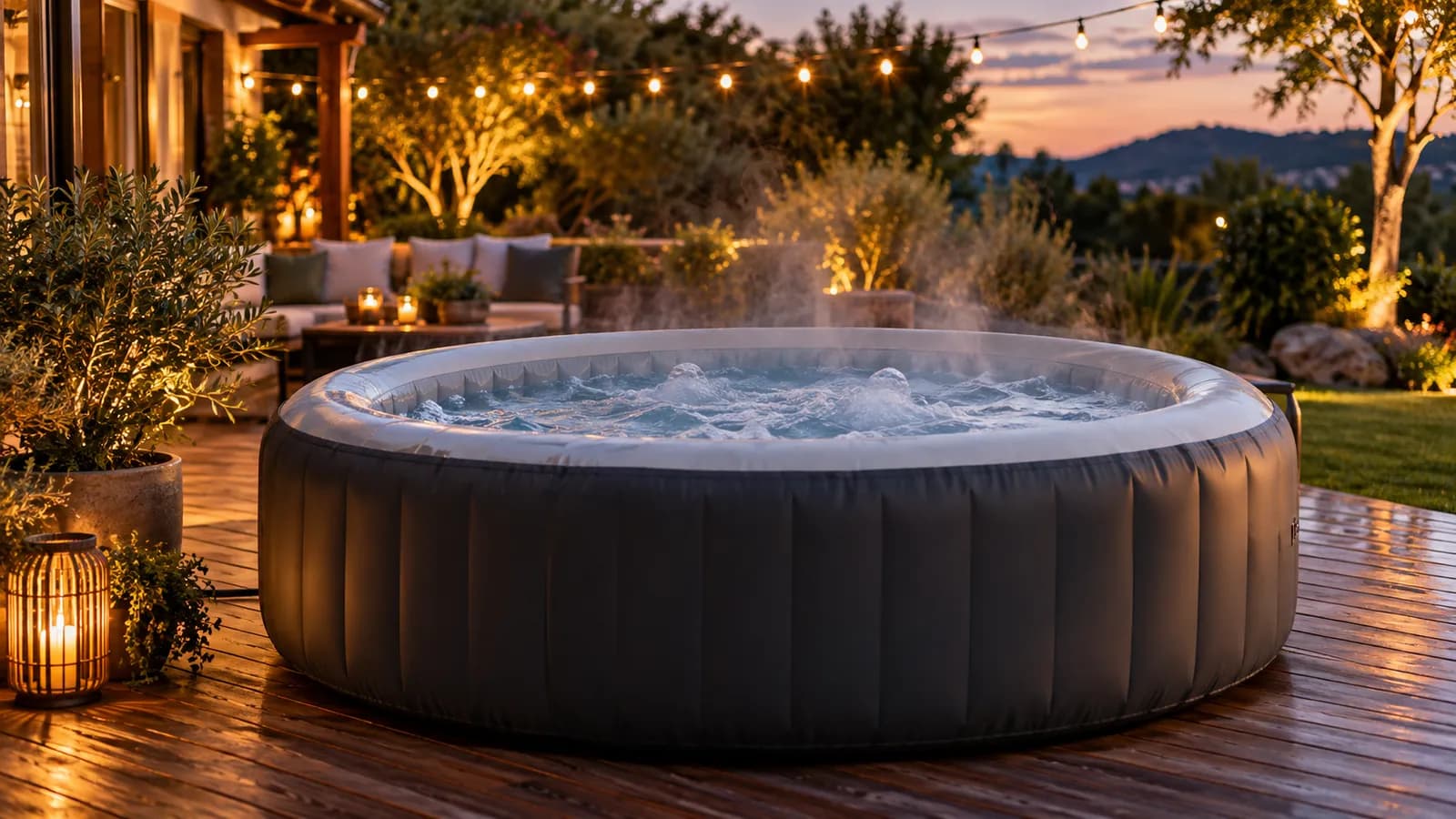
Inflatable hot tubs are the entry point to home soaking: set one up in an afternoon, plug it in, and you've got a hot tub for a fraction of the cost of an acrylic spa. They're not the same as a built-in tub, though, and it pays to know what you're getting.
Quick picks
- Best overall: Lay-Z-Spa AirJet series
- Best step-up: Lay-Z-Spa HydroJet Pro
- Best for cooler weather: MSpa
- Best budget: Intex PureSpa Plus
How we picked
Inflatable hot tub models change by season and retailer, so this research-based guide compares the product lines in our catalog. We consider stated capacity, insulation, electrical requirements, warranty and parts availability. We have not hands-on tested these tubs, measured their heating or noise, or conducted an owner survey. Treat heating performance and durability as questions to check for the exact model rather than results we have measured. See our methodology.
Our top picks
Best overall
Lay-Z-Spa AirJet series
The best-known inflatable hot tub line, with plenty of sizes.
Lay-Z-Spa offers a wide range of inflatable hot-tub sizes. Check the exact model's electrical requirements and whether your intended outlet and location are suitable. Heating time, insulation and pump noise are trade-offs to investigate before buying, especially for cooler weather.
What we like
- Wide range of sizes from 2-person to 6-person-plus
- Plug-in models can simplify setup where a suitable electrical supply is available
- Packs down for storage and can be used seasonally
Trade-offs
- Heats slowly, especially in cold weather
- Check pump noise, maintenance needs and replacement-part availability
- Best for
- Anyone testing the hot-tub life before committing to an acrylic spa.
- Skip it if
- You want year-round winter use in a cold climate.
Best step-up with real jets
Lay-Z-Spa HydroJet Pro series
A step up with real massage jets and a more robust build.
If air bubbles aren't enough, the HydroJet Pro series adds real massage jets, better insulation and a more robust build. Prices approach entry-level acrylic tubs in some configurations, and it's still an inflatable.
What we like
- Hydrojets provide a more spa-like massage than air bubbles
- Better insulation and heating than entry-level models
- Premium inflatable features like app control on some models
Trade-offs
- Priced near entry-level acrylic tubs in some cases
- Still an inflatable, with the associated maintenance and lifespan
- Best for
- Buyers who want jets and better winter performance without going acrylic.
- Skip it if
- You'd rather put the money toward an entry-level acrylic tub, or you want to avoid inflatable maintenance and lifespan limits.
Best for cooler weather
MSpa inflatable hot tubs
Inflatable hot tubs with a range of insulation and heater options.
MSpa offers inflatable models with different insulation and heater configurations. Compare the exact model's operating-temperature limits and insulation before choosing it for cooler weather; we haven't measured comparative heating performance. Check the warranty, parts availability and full setup cost.
What we like
- Often include better insulation and bigger heaters than basic inflatables
- Variety of sizes and styles
- A range of insulation and heater configurations to compare
Trade-offs
- Costs more than the cheapest inflatables
- Check warranty and replacement-part availability before buying
- Best for
- Buyers who want a better inflatable without spending acrylic-tub money.
- Skip it if
- You want the cheapest inflatable, or you can't confirm warranty and replacement-part availability.
Best widely available option
Coleman SaluSpa
A mainstream inflatable with strong retail availability.
A mainstream brand with broad retail availability and compact options for decks and patios. Same cold-weather limitations as other inflatables, and features vary a lot by model.
What we like
- Widely sold and well-documented, so support and parts are easy to find
- Compact options for patios and decks
- Easy to set up and take down
Trade-offs
- Same cold-weather limitations as other inflatables
- Features vary a lot between models — compare specs
- Best for
- Casual use in mild climates.
- Skip it if
- You plan to use it through cold winters, or you won't compare specs across models, since features vary a lot.
Best budget
Intex PureSpa Plus
A budget-friendly inflatable with quick setup.
One of the lowest-priced inflatables of its size, simple to set up and use. The heater struggles in cool weather and the materials are lighter-duty — it's best for summer.
What we like
- Typically one of the lowest-priced inflatables of its size
- Simple setup and operation
- Plugs into a standard GFCI outlet
Trade-offs
- Basic heater struggles in cold weather
- Cheaper materials than premium inflatables
- Best for
- Price-sensitive buyers for summer use.
- Skip it if
- You want to use it through cold weather.
What to know before you buy
Heating is slow
Most inflatables heat water by only a degree or two per hour, so plan ahead — start heating a day before you want to soak, and keep the cover on. In cold weather the heater may struggle to reach or hold temperature.
Location and base
Place the tub on a flat, level, smooth surface with a ground cloth or insulated floor mat. A filled hot tub weighs a lot, so make sure the surface can support it. Don't place it where water can pool around the electrical connections.
Power and safety
Use a GFCI-protected outlet as required by the manufacturer. Follow the manual's instructions for placement and never use electrical devices in or near the water.
Water care
Like any hot tub, an inflatable needs regular water testing, sanitizer and filter cleaning. Water changes every few months are typical.
Noise and lifespan
Pumps can be loud, and inflatables don't last as long as acrylic tubs. Think of them as a multi-season purchase rather than a decade-long one.
When to skip inflatable
If you want to soak year-round in a cold climate, or you want powerful jets and a long-lasting spa, save for an acrylic hot tub. See our hot tub buying guide.
Add-ons worth considering
An insulated floor mat, a thermal cover, a water test kit and a hot tub chemical starter pack are the most useful extras.
Frequently asked questions
Are inflatable hot tubs worth it?
For many people, yes — as a low-cost way to try hot tubbing without committing thousands of dollars. They're best for mild climates and seasonal use. If you want a spa you can use all winter, an insulated acrylic tub is a better long-term buy.
Do inflatable hot tubs need special electricity?
Most plug into a standard GFCI-protected household outlet; check the manual for your model. Don't use an extension cord unless the manufacturer says you can, and place the pump and electrical connections away from standing water.
How long do inflatable hot tubs last?
Typically a few seasons with care. Pumps, seals and covers are the usual failure points. Keep the cover on, balance the water and drain and store it properly in freezing weather.
Can I use an inflatable hot tub in winter?
Some models are rated for cold weather, but heating is slower and the running cost is higher. Check the temperature range on the model you're considering, use a good cover and an insulated base.
Alex Mercer brings 15 years of experience and a practical editorial approach to Backyard Review. Alex compares published product information, installation needs and ownership costs, highlighting trade-offs and distinguishing research from documented hands-on experience.