Our top picks at a glance
Buy first
Perforated aluminum pizza peel (12–14 in)Check pricePrice tier 1 of 4:Under $150Anyone with a pizza oven — buy this before anything else.Best for consistency
Infrared thermometer gun (rated to 1,000°F+)Check pricePrice tier 1 of 4:Under $150Anyone who wants consistent results on the first pizza, not the third.Best for dough
Digital kitchen scale (1 g precision)Check pricePrice tier 1 of 4:Under $150Anyone making their own dough.Best insurance
Weatherproof pizza oven coverCheck pricePrice tier 1 of 4:Under $150Any oven that lives outdoors.
You can buy a top-tier pizza oven and still make bad pizza if you launch it with the wrong tool or bake on a cold stone. These four inexpensive accessories solve the most common first-month problems.
Our top picks
Buy first
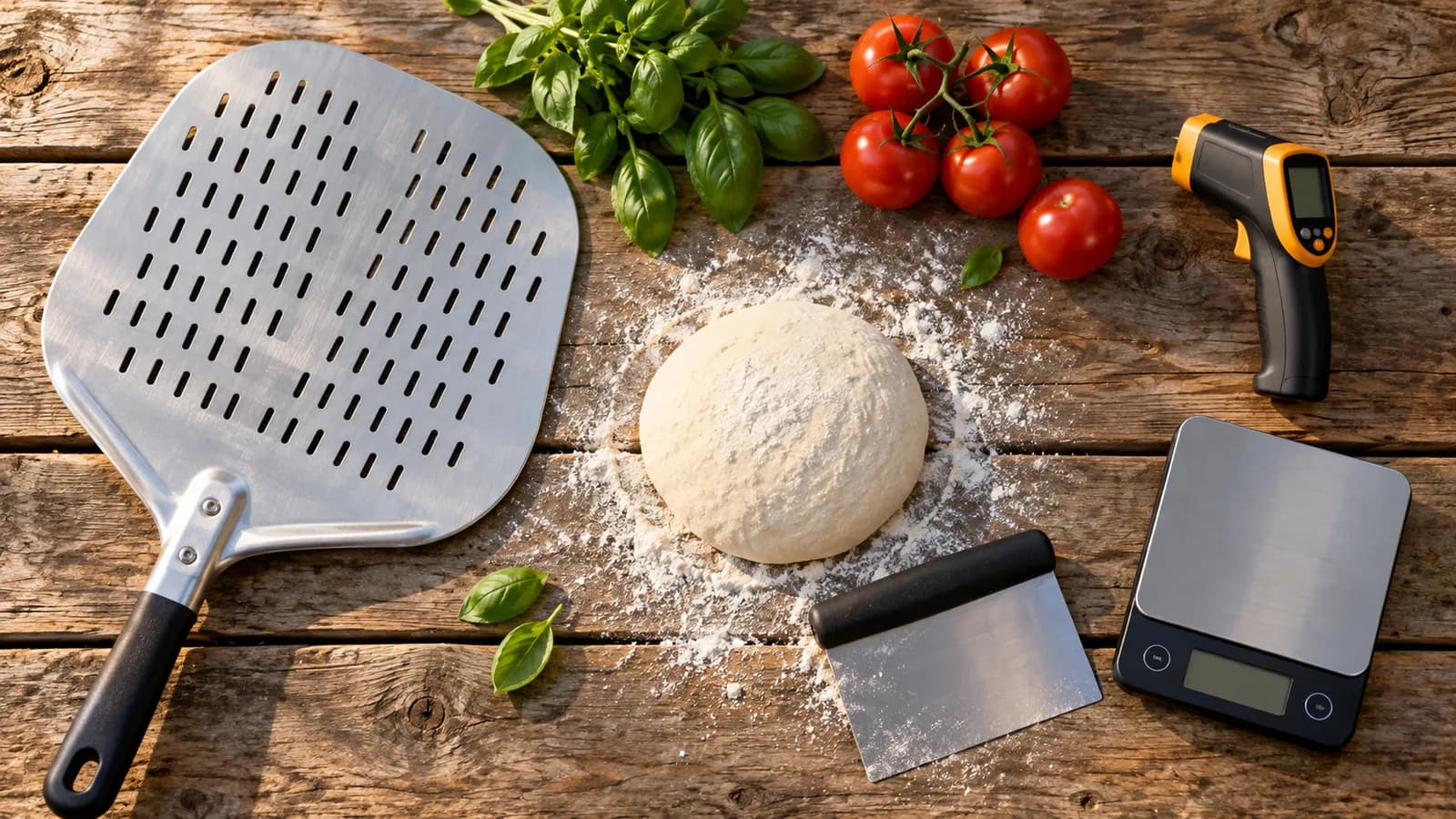
Perforated aluminum pizza peel (12–14 in)
The tool you'll touch every single pizza.
You'll touch this on every single pizza. A thin, perforated aluminum peel with a long handle slides under a finished pie easily and shakes off excess flour, which would otherwise burn and taste bitter. Choose a size a little smaller than your oven's maximum pizza size so it turns easily inside.
What we like
- Perforations shake off excess flour, so it doesn't burn on the stone
- Thin aluminum slides easily under a finished pizza
- Light enough for one-handed turning
Trade-offs
- Aluminum handles get hot near the oven — pick one with a long, insulated handle
- Best for
- Anyone with a pizza oven — buy this before anything else.
- Skip it if
- You already own a peel with a long, insulated handle.
Best for consistency
Infrared thermometer gun (rated to 1,000°F+)
The easiest way to know the stone is actually ready.
Nothing teaches you faster. Point it at the stone and you know whether it's ready, instead of guessing. Check the maximum temperature rating — cheap models stop far below pizza-oven temperatures.
What we like
- Instantly reads the stone surface temperature
- Prevents under-heated stones and burnt bottoms
- Handy for grills, griddles and smokers too
Trade-offs
- Cheap units top out at low temperatures — check the maximum rating before buying
- Best for
- Anyone who wants consistent results on the first pizza, not the third.
- Skip it if
- You already have one, or the only model in reach tops out below pizza-oven temperatures.
Best for dough
Digital kitchen scale (1 g precision)
Dough is chemistry — weigh your flour and water.
Dough works by percentages, not cups. A scale that reads in 1-gram steps makes your dough repeatable, and it works with our free dough calculator.
What we like
- Weighing ingredients by gram makes dough repeatable
- Required to use baker's-percentage dough recipes (see our free dough calculator)
- Doubles as an everyday kitchen scale
Trade-offs
- Look for a scale that measures in 1 g increments — 5 g jumps are too coarse for yeast
- Best for
- Anyone making their own dough.
- Skip it if
- You buy ready-made dough, or the scale you're considering only steps in 5 g increments.
Best insurance
Weatherproof pizza oven cover
Cheap insurance for a $500+ purchase.
A cover made for your exact oven protects the stone, burner and finish from rain and pollen. Wait until the oven is fully cool before covering.
What we like
- Keeps rain, pollen and bird droppings out
- Extends the life of stone, paint and fittings
- Fabric covers designed for your exact model fit better than generic ones
Trade-offs
- Never cover an oven until it is completely cool
- Best for
- Any oven that lives outdoors.
- Skip it if
- Your oven lives indoors or in a garage.
Nice-to-haves
Once the basics are covered, consider:
- A turning peel — a small round peel for rotating the pizza mid-bake.
- A bench scraper — for dividing and shaping dough.
- Proofing containers with lids — keeps dough balls from drying out.
- A long-handled brush — cleans ash and flour off the stone while it's hot.
- Heat-resistant gloves — useful for handling a hot oven door or fuel tray.
Brand-specific vs. generic
Brand-specific accessories (like a peel sold by your oven's maker) usually fit well and look good together, but generic ones often cost less and work just as well. Fabric covers are the exception: a cover made for your exact model fits much better than a generic one.
Start with the dough
Great pizza starts before the oven. Use our free pizza dough calculator to get exact weights, and see our best pizza ovens guide if you haven't bought an oven yet.
Frequently asked questions
What size pizza peel should I buy?
Choose one that's slightly smaller than your oven's maximum pizza size — a 12-inch peel for a 12- or 14-inch oven, for example. A peel that's too big is awkward to turn in a small oven.
Do I need a launching peel and a turning peel?
A perforated or standard peel for launching and a smaller turning peel for rotating the pizza make cooking easier, but you can start with a single peel and add a turning peel later.
What else is worth buying?
A bench scraper for dividing dough, a pizza cutter or rocker blade, proofing containers with lids and a long-handled brush for cleaning the stone are all handy.
Alex Mercer brings 15 years of experience and a practical editorial approach to Backyard Review. Alex compares published product information, installation needs and ownership costs, highlighting trade-offs and distinguishing research from documented hands-on experience.