Our top picks at a glance
Best overall
Solo Stove Bonfire 2.0See itPrice tier 2 of 4:$150–$500Most households with a patio or lawn who want an easy, mostly smokeless fire.Best for large groups
Solo Stove Yukon 2.0See itPrice tier 3 of 4:$500–$1,500Entertainers with larger seating areas.Best for small spaces
Solo Stove Ranger 2.0See itPrice tier 2 of 4:$150–$500Small spaces, couples and travel.Best permanent fire pit
Breeo X SeriesSee itPrice tier 3 of 4:$500–$1,500People who want a permanent centerpiece that doubles as an outdoor cooking station.Best portable with tech
BioLite FirePit+See itPrice tier 2 of 4:$150–$500Campers and tailgaters who also want a patio fire pit.
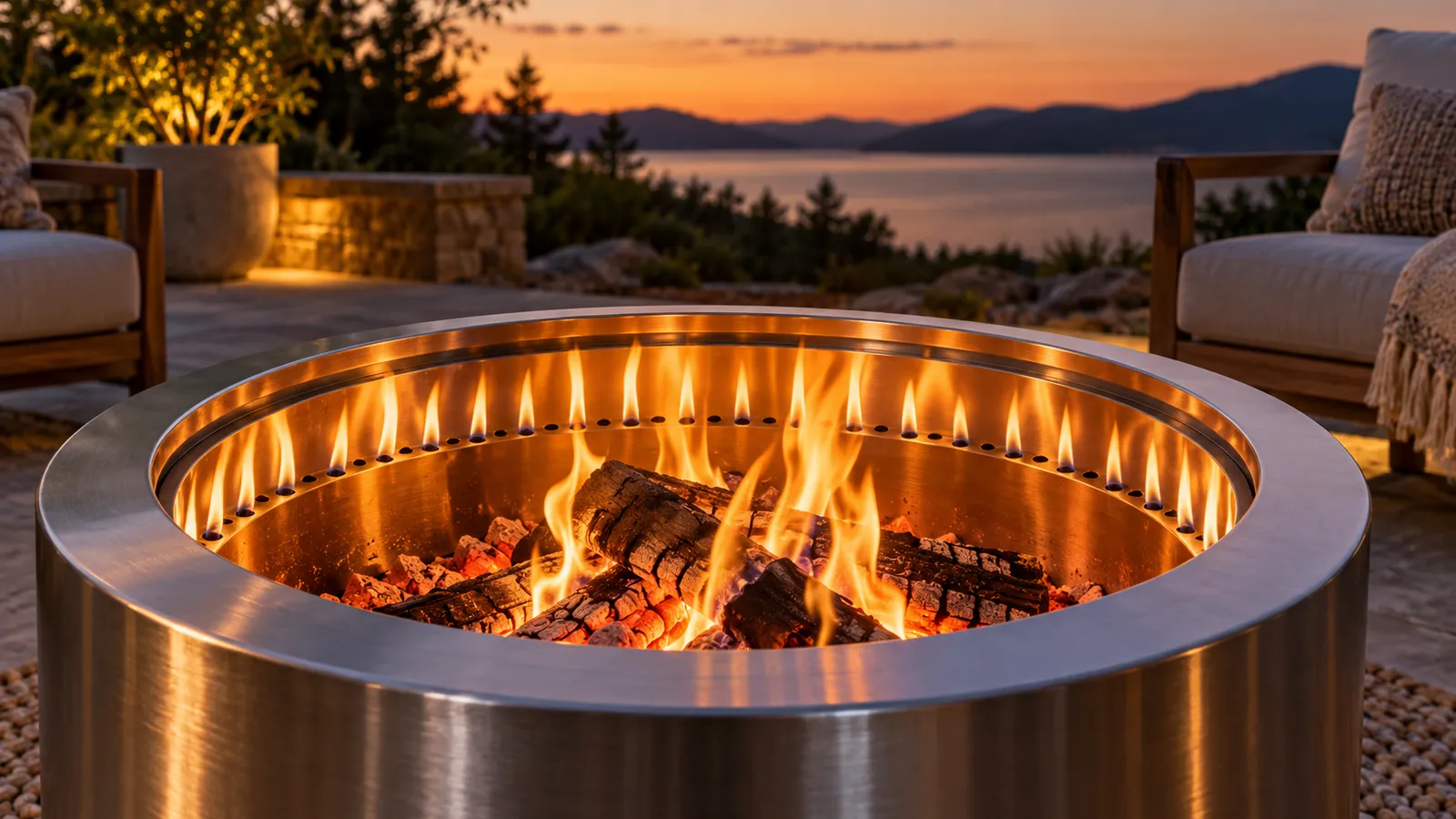
A traditional fire pit is wonderful until the wind shifts and everyone has smoke in their eyes. Smokeless fire pits use clever airflow — usually a double wall that feeds oxygen to the fire from below and above — to burn wood more completely. The result is a hotter, cleaner burn with far less smoke, as long as you use dry hardwood.
Quick picks
- Best overall: Solo Stove Bonfire 2.0
- Best for bigger groups: Solo Stove Yukon 2.0
- Best permanent pit: Breeo X Series
- Best compact: Solo Stove Ranger 2.0
How we picked
We compared the leading smokeless fire pits on airflow design, material and durability, size and weight, accessory support and value, drawing on manufacturer information and independent reviews. We describe sizes in general terms because specs vary by generation; check the current listing for exact dimensions. See our methodology.
Our top picks
Best overall
Solo Stove Bonfire 2.0
The default smokeless fire pit — and still the best all-rounder.
The Bonfire 2.0 is still the default for good reason. Its double-wall design draws air through the pit so wood burns more completely, which means noticeably less smoke when you burn dry hardwood. It's stainless steel, portable, and supported by a huge range of accessories. Stainless discolors with heat — that's normal.
What we like
- Double-wall design pulls air through to burn wood more completely, so less smoke
- Portable stainless steel construction that's easy to move and store
- Large accessory ecosystem: stands, shields, lids, cooking tools
Trade-offs
- Needs dry, seasoned wood to stay smokeless
- Stainless steel discolors with heat — that's normal, but not everyone likes it
- Best for
- Most households with a patio or lawn who want an easy, mostly smokeless fire.
- Skip it if
- You want a pit you can leave out and forget — consider a heavier steel pit.
Best for large groups
Solo Stove Yukon 2.0
The big-group version for patios with room to spare.
The Yukon 2.0 uses the same smokeless airflow in a bigger bowl, warming a wider circle of chairs. It's heavier and pricier, and too much fire for a small patio.
What we like
- Larger fire bowl that comfortably warms a bigger circle of chairs
- Same smokeless airflow design as the Bonfire
- Works with Solo Stove's stands and accessories
Trade-offs
- Significantly heavier and pricier than the Bonfire
- Too much fire for small patios
- Best for
- Entertainers with larger seating areas.
- Skip it if
- You have a small patio or rarely host more than four people.
Best for small spaces
Solo Stove Ranger 2.0
The compact portable for patios, camping and small yards.
A compact, lightweight option for small patios, balconies and camping. It warms two to four people and burns small logs quickly.
What we like
- Small footprint that suits compact patios and camping
- Smokeless design in a lightweight package
- One of the lower-priced Solo Stove pits
Trade-offs
- Warms fewer people — best for two to four
- Burns through small logs fast
- Best for
- Small spaces, couples and travel.
- Skip it if
- You regularly host more than a handful of people, or you want long burns without feeding small logs.
Best permanent fire pit
Breeo X Series
The heavy-duty smokeless pit built to live outside.
Breeo's X Series is built from thick Corten steel and designed to live outside year-round, with an extensive range of cooking accessories. It's heavy and costs more than portable pits — a purchase for a permanent fire spot.
What we like
- Thick Corten steel that's built to weather outdoors for years
- Smokeless airflow design and a wide range of cooking accessories
- Available in multiple sizes up to large installations
Trade-offs
- Heavy — plan on a permanent location
- Costs more than portable stainless pits
- Best for
- People who want a permanent centerpiece that doubles as an outdoor cooking station.
- Skip it if
- You want something portable or inexpensive.
Best portable with tech
BioLite FirePit+
A portable, fan-assisted fire pit with app control.
A battery-powered fan boosts airflow, folding legs make it easy to transport, and an app lets you adjust the burn. More electronics means more that can fail, and it's smaller than backyard pits.
What we like
- Battery-powered fan helps the fire burn cleanly and quickly
- Folds down for transport and storage
- Doubles as a grill with the optional accessories
Trade-offs
- Relies on a battery and electronics, so there's more to go wrong than with a simple steel pit
- Smaller capacity than backyard-oriented pits
- Best for
- Campers and tailgaters who also want a patio fire pit.
- Skip it if
- You'd rather avoid batteries and electronics, or you need a big backyard-sized fire.
How to choose
Portable or permanent?
Stainless steel pits like the Solo Stove are lighter and easy to store or move. Heavy Corten-steel pits like the Breeo are made to live outside year-round, but you'll want a permanent location.
Size
Bigger pits warm more people but burn more wood and need more space. Measure your seating area and consider how many people you usually host.
Material
Stainless steel resists rust and discolors with heat. Corten (weathering) steel develops a protective rust patina and can stain nearby surfaces for a while.
Accessories
Stands, heat shields, lids, spark screens and cooking tools expand what you can do — and protect surfaces below. A stand matters if you're burning on a deck or patio.
Wood supply
Smokeless pits need dry, small split logs. Keep a dry storage spot and budget for seasoned hardwood.
Safety first
A smokeless fire is still a fire. Keep it away from your house and overhanging branches, check your local burn rules and have a hose or extinguisher nearby. Read how far a fire pit should be from your house before you choose a spot.
Want something that doesn't use wood?
See our comparison of wood vs. propane fire pits.
Frequently asked questions
Are smokeless fire pits really smokeless?
They produce far less smoke than an open fire when burned correctly — mostly during steady burning with dry, seasoned hardwood. Wet wood, softwood and the first few minutes after lighting still smoke.
What wood should I burn?
Dry, seasoned hardwood (oak, maple, hickory, ash) in small, split pieces. Avoid wet or treated wood, softwood with lots of resin, and anything painted or pressure-treated.
Can I use a smokeless fire pit on a deck?
Only with a heat shield or stand that the manufacturer says is suitable. Otherwise use a fireproof pad or put the pit on pavers or gravel. See our guide to fire pit clearances (linked below) before you pick a spot.
How do I clean a smokeless fire pit?
Let it cool completely, empty the ash (dispose of it in a metal container, since embers can stay hot for a long time), and wipe down the steel. Keep a cover on it to avoid rain pooling.